
ADOC Release and Discharge Paths
Alabama Department of Corrections custody is statewide prison custody. It is not Houston County Jail custody. A Houston County case can lead to ADOC when a person is sentenced to state prison or transferred after a local jail stay. At that point, the county jail record may show a release from county custody, but that release may mean transfer to ADOC rather than release into the community. The later state release, parole, end-of-sentence discharge, or supervision event belongs to ADOC and the Alabama Bureau of Pardons and Paroles.
The ADOC inmate search is designed for current state custody. The research file says ADOC states that its database contains only currently incarcerated inmates and that historical data is not available online. That one fact controls the page. If a Houston County person is still in ADOC custody, the online search can show current state fields. If the person has already been released or discharged from ADOC, the public web search may not return historical data, and the next route is ADOC records, parole board records, the court case, or a public-records request.
ADOC's terminology matters. The "Minimum Release Date" is not a guarantee. ADOC defines it as the earliest scheduled date an inmate can be released to probation or end of sentence, and the date can change if good time is lost or if a circuit clerk sends new cases or changes the current sentence. The "Parole Consideration Date" is a tentative date set by the Parole Board. "Parole Status" indicates whether the person is currently on parole, declared delinquent, or revoked. These fields are state-prison fields, not routine county jail booking fields.
Confirm an ADOC Release
Use the ADOC inmate search first only if the question concerns current Alabama state prison custody. Search by AIS number if known because ADOC says the AIS number is the unique six-digit number assigned by the department and that AIS search takes precedence over name search. If AIS is not known, search by name and compare identity details. A missing result does not prove the person was never in ADOC custody because the search is not a historical archive.
- Check whether the Houston County Jail record shows release to ADOC or another state custody event.
- Search the ADOC inmate search by AIS number or name.
- Review Minimum Release Date, Parole Consideration Date, Parole Status, sentence, and custody fields when a current record appears.
- If the online search has no historical record, use ADOC's public-records process for release or discharge documentation.
- Compare ADOC data with Houston County court records and parole board records when release or supervision is disputed.
| ADOC field | What it means | How to use it |
|---|---|---|
| AIS number | Unique six-digit ADOC identifier | Best search key when known |
| Minimum Release Date | Earliest scheduled release to probation or end of sentence | Treat as scheduled, not final |
| Parole Consideration Date | Tentative board-set consideration date | Not the same as a release date |
| Parole Status | Parole, delinquent, revoked, or related state status | Confirm with parole records when needed |
| Historical data | Not available online in the ADOC search | Use ADOC records requests |
The ADOC route is especially important when a Houston County Jail release record says transfer. The county record can answer when local custody ended. It cannot prove the later state prison release or discharge. For county jail release-only questions, use Houston County Jail. For state prison release after a Houston County sentence, use ADOC and the parole board.
ADOC Records Contact
ADOC provides a formal public-records route. The research file identifies the ADOC Public Records Coordinator email, phone, public-records form, and fee instruction. ADOC Form 023-A is required for public-records requests, and the current form instructions describe a $20 non-refundable processing fee. ADOC Administrative Regulation No. 023 distinguishes standard requests from time-intensive requests using an estimated eight-hour processing threshold. Use this route for older release or discharge records when the public search does not show historical data.
A state-prison release request should identify the person by full name, AIS number if known, date of birth if lawful and known, sentencing county, approximate custody dates, and the specific record sought. Ask for public release or discharge date, sentence information, custody status history, public photo if available, and public supervision or discharge records. If the issue is why the person was sent to ADOC in the first place, the Houston County court file may be the better record.
The ADOC inmate search source is matched in the manifest as an official state custody path. The screenshot shows the state offender-search source used for ADOC-related release routing.
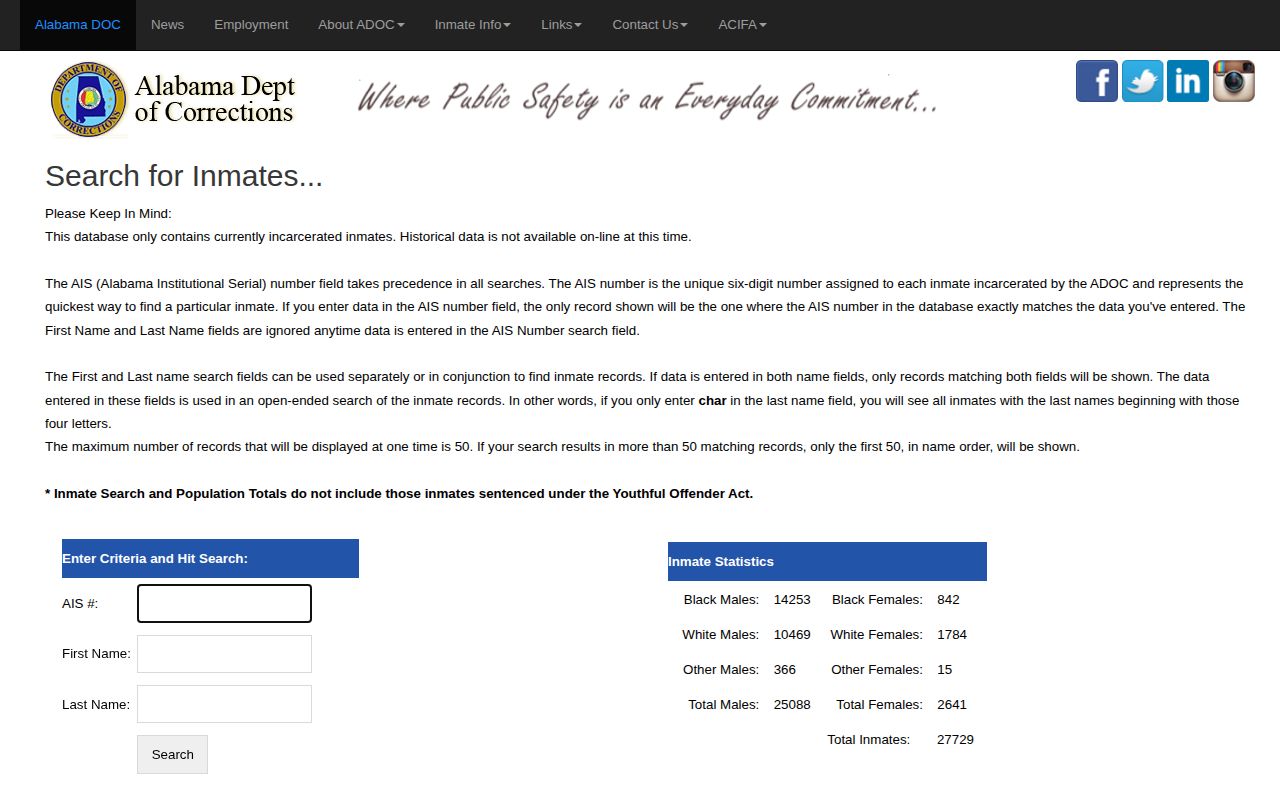
Use that public search for current ADOC custody. Use the records coordinator and form when the question concerns a past release or discharge that the search no longer displays.
About ADOC State Custody
ADOC facilities are statewide state-prison facilities, not Houston County detention facilities. The facility map includes ADOC as a service path because Houston County cases can move from local jail to state prison. That move changes the release search. A pretrial county detainee has no ADOC minimum release date. A sentenced state prisoner may have ADOC fields tied to state custody, good-time eligibility, sentence changes, and parole-board action.
Alabama Correctional Incentive Time, often called good time, is governed by Ala. Code Section 14-9-41. The research file captures current public summaries listing Class I credit at 30 days for each 30 days served, Class II at 15 days, Class III at 5 days, and Class IV at none. It also lists exclusions such as Class A felony, life, death, sentence over 15 years, and certain offense categories. The safe rule for readers is simple: do not use a blanket formula. Confirm the actual ADOC field, sentence, good-time class, court changes, detainers, and parole status.
ADOC's Minimum Release Date is scheduled and can change. Actual release is confirmed only after ADOC, parole, or court records show the completed event.
ADOC Parole Release Checks
Parole is not the same as end-of-sentence discharge. The Alabama Bureau of Pardons and Paroles handles parole hearings and results. The research file says parole and pardon hearings are generally held in open public meeting on Tuesday, Wednesday, and Thursday unless otherwise noted, and the Bureau publishes scheduled hearings, current-year results, previous-year results, and hearing minutes. A parole consideration date in ADOC is a lead, not a decision. The board's result must be checked separately.
Houston County has a local supervision office in Dothan for probation and parole field work. The Dothan Field Office serves Houston County and has its own address, phone, fax, hours, and lunch closure in the research. After a person leaves ADOC on parole or probation supervision, release verification may require both ADOC custody history and parole/probation contact. State custody ending does not always mean all supervision has ended.
- Parole
- Conditional release from prison supervision after board action, with rules and possible revocation.
- Probation
- Court-ordered supervision that may occur instead of or after jail or prison time.
- End of sentence
- Completion of the sentence term in the custody system, subject to official record confirmation.
County Jail vs ADOC Release
A Houston County Jail release and an ADOC release are not interchangeable. The county jail release record can show that Houston County custody ended on a date. If the person was transferred to state prison, that is not the same as a state prison discharge. ADOC later controls state sentence calculations, minimum release dates, parole consideration fields, custody status, and state public-records requests. The two records should be reconciled, not merged.
For a complete timeline, collect the Houston County Jail booking and release entry, the Houston County court disposition, the ADOC current or records-request response, and any parole-board action if supervision applies. If one source conflicts with another, the agency that owns the event usually controls that part of the timeline. The county owns county jail release. ADOC owns state custody. The court owns the order. The parole board owns parole action.
Public Record Search
Sponsored Results